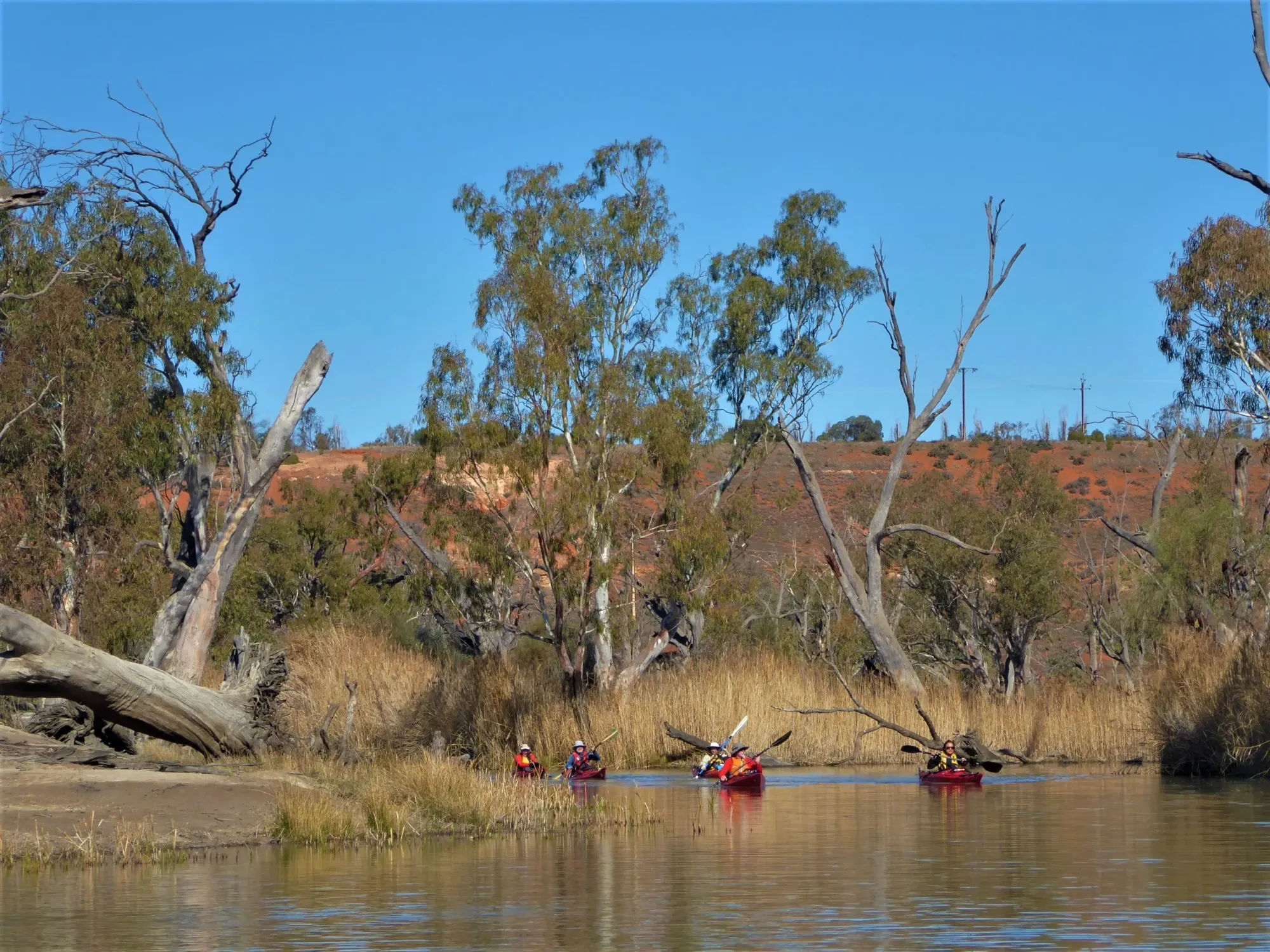
Pike River Rumpagunyah Creek Loop Trail
A 24 km loop along the Pike River and Rumpagunyah Creek near Lyrup — exploring the quiet backwaters of the Pike Floodplain with an optional overnight camp along the creek. No portages required.
- Distance
- 24 km approx.
- Difficulty
- Easy – Moderate
- Trail type
- Loop
- From Adelaide
- 260 km north-east
The Pike River Rumpagunyah Creek Loop is a rewarding day paddle through the back-country of the Pike Floodplain — tracing the lower Pike River west to the Murray, turning upstream along the main channel, and returning via the sheltered waterway of Rumpagunyah Creek. At 24 km it makes an achievable long day paddle, or a relaxed overnight trip with good camping along the creek. No portages are required, and the trail sits entirely below the Pike River regulators so water levels remain stable regardless of upstream floodplain watering operations.
About This Trail
This loop trail is described travelling clockwise from the pump house launch site, but it can equally be paddled in the reverse direction. The route begins on the Pike River, travels west to the Murray River, heads upstream along the Murray, and enters Rumpagunyah Creek for the return leg back to the launch.
Unlike the companion Pike River Mundic Creek Trail, this trail has no portages and is not affected by changing water levels in the Pike Floodplain — being entirely downstream of both Lock 5 and the Pike River regulators. Rumpagunyah Creek gradually widens as you travel along it, and the labyrinth of side creeks near the return section is navigable by keeping left to reach the pump house.

Paddle SA is the governing body of paddle sport and recreation in South Australia. It leads and supports paddling in South Australia and encourages the safe exploration of our waterways.
Paddling Trails South Australia has a range of trails to suit different abilities. Know your ability.
🌐 paddlesa.au →Launch Site & Route
There is one launch site for this trail, at the pump house on the Pike River off Stanitzki Road, Lyrup.
| Site | Location | Notes |
|---|---|---|
| Pump House — Pike River | 1018 Stanitzki Road, Lyrup. Turn off the road at GPS 34.2784 S; 140.7441 E (opposite entrance to Aroona Farms Simarloo Orchard). Shady trees available for car parking. |
Route Description
- Launch → Point L — Murray River Junction (approx. 6.3 km west): From the pump house, turn left and travel in a westerly direction for approximately 6.3 km, keeping left, until you reach the Murray River at Point L (GPS 34.2598 S; 140.6832 E).
- Point L → Point M — Rumpagunyah Creek Entrance (approx. 10.5 km upstream): Turn hard right at Point L and travel upstream (south-east) along the Murray River for approximately 10.5 km to the entrance to Rumpagunyah Creek at Point M (GPS 34.2399 S; 140.7356 E). Note: there is a small island in the river just after the entrance to the creek — keep right to enter Rumpagunyah Creek.
- Point M → Point A — Island Junction (approx. 3 km): Travel along Rumpagunyah Creek, which gradually widens as you head inland. After approximately 3 km from the Murray River you will reach an island with a creek entering from the right at Point A (GPS 34.2527 S; 140.7616 E). Turn into this creek on the right.
- Point A → Launch — Pump House (approx. 4.2 km): Travel down this creek for approximately 4.2 km to return to your starting point at the pump house on the Pike River. There is a labyrinth of side creeks in this area — if you keep left you will reach the pump house launch site. Even if you enter a side creek, continuing and keeping left will still bring you to the Pike River and your starting point.
Wildlife & Environment
The Pike Floodplain is one of the Riverland’s most ecologically significant landscapes — a vast anabranch and backwater system spanning more than 6,700 hectares between Paringa and Lyrup. The dominant vegetation along the waterways is open woodland of Eucalyptus camaldulensis (river red gum) and E. largiflorens (black box), with an understorey of lignum ( Muehlenbeckia cunninghamii), saltbush ( Atriplex vesicaria) and various shrublands. Reedbeds of Typha sp. and common reed ( Phragmites australis) line the shores of lagoons and quieter backwaters.
The area is a valuable feeding and breeding habitat for waterbirds. Environmental monitoring has recorded 38 species of waterbird through spring to autumn in recent years, including rare visitors such as the great crested grebe, Australasian shoveler and musk duck. Australian shelduck, yellow-billed spoonbill and black-fronted dotterel have also been observed breeding in the area, while wedge-tailed eagles, grey butcherbirds and dusky woodswallows are resident. Paddling quietly at dawn offers exceptional birdwatching through the entire system.
Native fish species sampled in the system include Murray cod (listed as vulnerable), freshwater catfish (a protected species in South Australia), bony herring and a range of smaller-bodied native species. Fish passage through the floodplain has been significantly improved in recent years through the installation of fishways as part of the Riverine Recovery Project.
Country & Heritage
The First People of the River Murray and Mallee Region are the Traditional Owners of the Pike Floodplain, with deep cultural connections to this landscape stretching back tens of thousands of years. The River Murray is understood as the life blood of Country, bringing First Peoples communities together through living culture, ceremony and shared knowledge of the waterways.
Research led by Flinders University in collaboration with the River Murray and Mallee Aboriginal Corporation (RMMAC), with radiocarbon dating conducted at ANSTO, confirmed that shell midden sites overlooking the Pike River floodplain downstream of Renmark record Aboriginal occupation extending to approximately 29,000 years — making this the oldest known River Murray Indigenous site in South Australia. The middens are the remnants of meals eaten by the people who called this river home across deep time, a tangible connection to the generations who paddled and fished these same waterways.
Paddling Trails South Australia acknowledges the First People of the River Murray and Mallee Region as the Traditional Owners of these lands and waters, and pays respect to Elders past, present and emerging.
Pike River Conservation Park
The trail passes through land adjacent to the Pike River Conservation Park, proclaimed on 1 February 1979 under the National Parks and Wildlife Act 1972. The park covers approximately 2.88 km² at the northern end of the Mundic Creek locality and is classified as an IUCN Category III protected area. It is one of 359 protected areas in South Australia. The broader Pike Floodplain is Crown Land, with the majority of it protected under the National Reserve System.
For more information on floodplain ecology and environmental watering, see the Department for Environment and Water — Pike Floodplain page.
Trail Gallery
4 photos