Punkah Island Loop Trail
A 29 km two-day loop around Punkah Island through the ancient waterways of Chowilla Game Reserve — one of the Murray’s most remote and ecologically rich floodplain systems. Starts and finishes at the Border Cliffs campground canoe launch.
- Distance
- 29 km approx.
- Difficulty
- Easy – Moderate
- Trail type
- Loop
- From Adelaide
- 265 km north-east
The Punkah Island Loop is a two-day wilderness paddle through the intricate creek system of the Chowilla Game Reserve — one of the lower Murray’s most ecologically significant and remote floodplain landscapes. The trail winds through Hypurna Creek, Salt Creek, Punkah Creek and Slaney Creek, circling Punkah Island through towering river red gum forest before returning to the Murray via a short portage. Phone reception is unreliable throughout; satellite communication is strongly recommended.
About This Trail
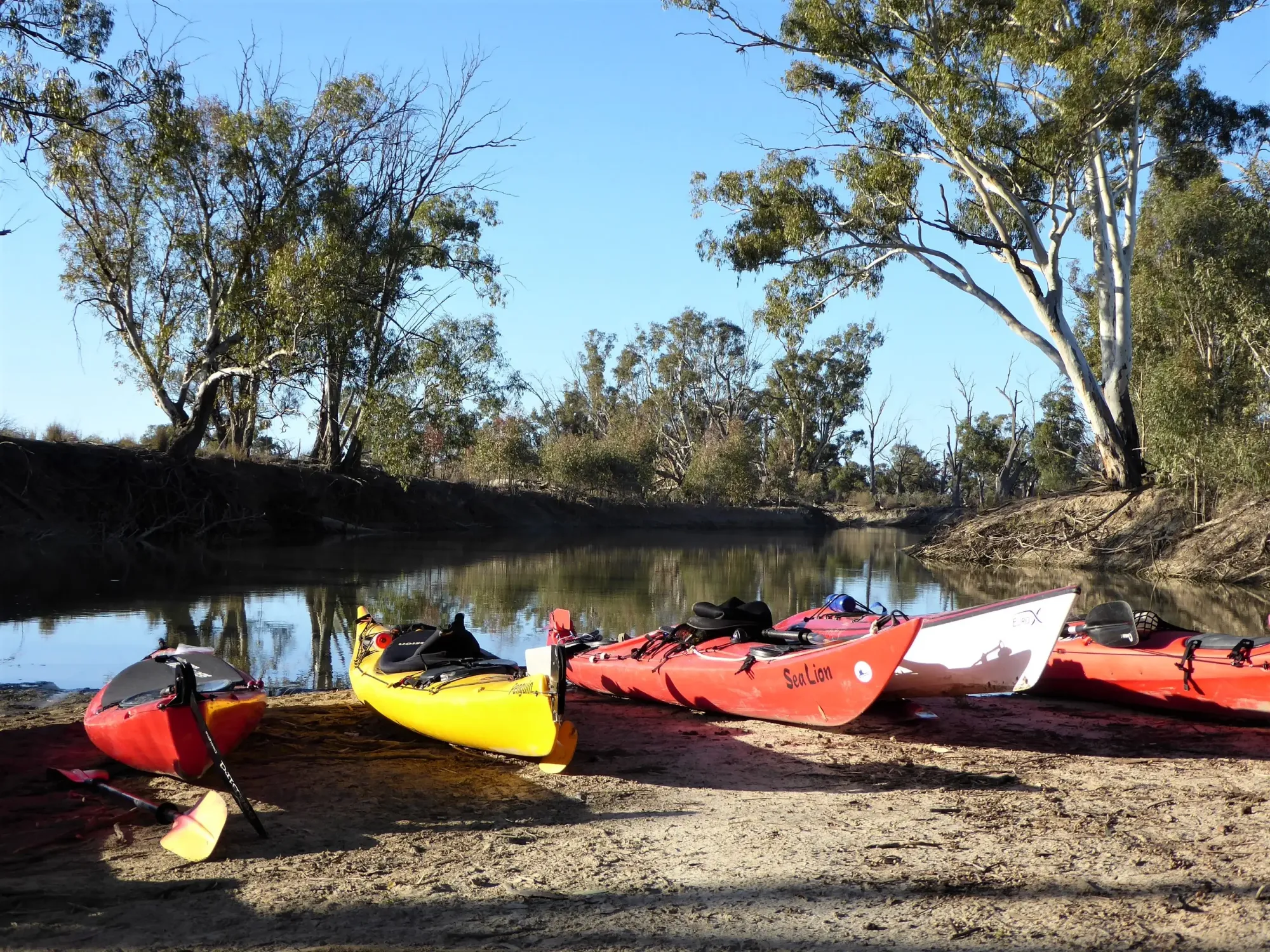
This trail is a loop paddle around Punkah Island, travelling through a connected network of creeks entirely within the Chowilla Game Reserve and Chowilla Regional Reserve. The route is described anti-clockwise starting at the Border Cliffs campground canoe launch. Most of the paddling is through sheltered creek environments under the shade of river red gums, with only the brief portage section requiring any out-of-boat effort.
The trail begins with a downstream paddle to enter “the Shute” — a fast-flowing, narrow creek approximately 150 m long that links the Murray River directly to Hypurna Creek. The Shute is recommended for experienced paddlers only due to the risk of being forced against fallen trees. An alternative portage route exists for those who prefer to bypass it (see Route section below).

Paddle SA is the governing body of paddle sport and recreation in South Australia. It leads and supports paddling in South Australia and encourages the safe exploration of our waterways.
Paddling Trails South Australia has a range of trails to suit different abilities. Know your ability.
🌐 paddlesa.au →Launch Site & Route
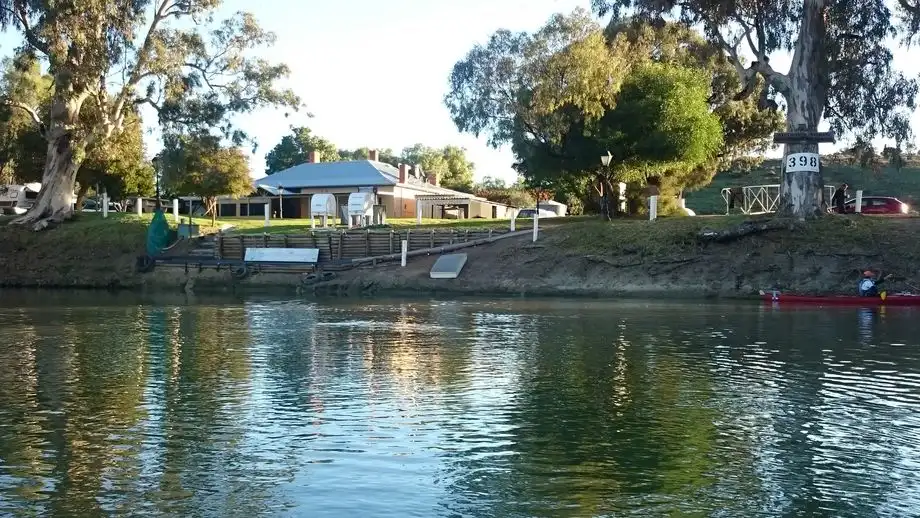
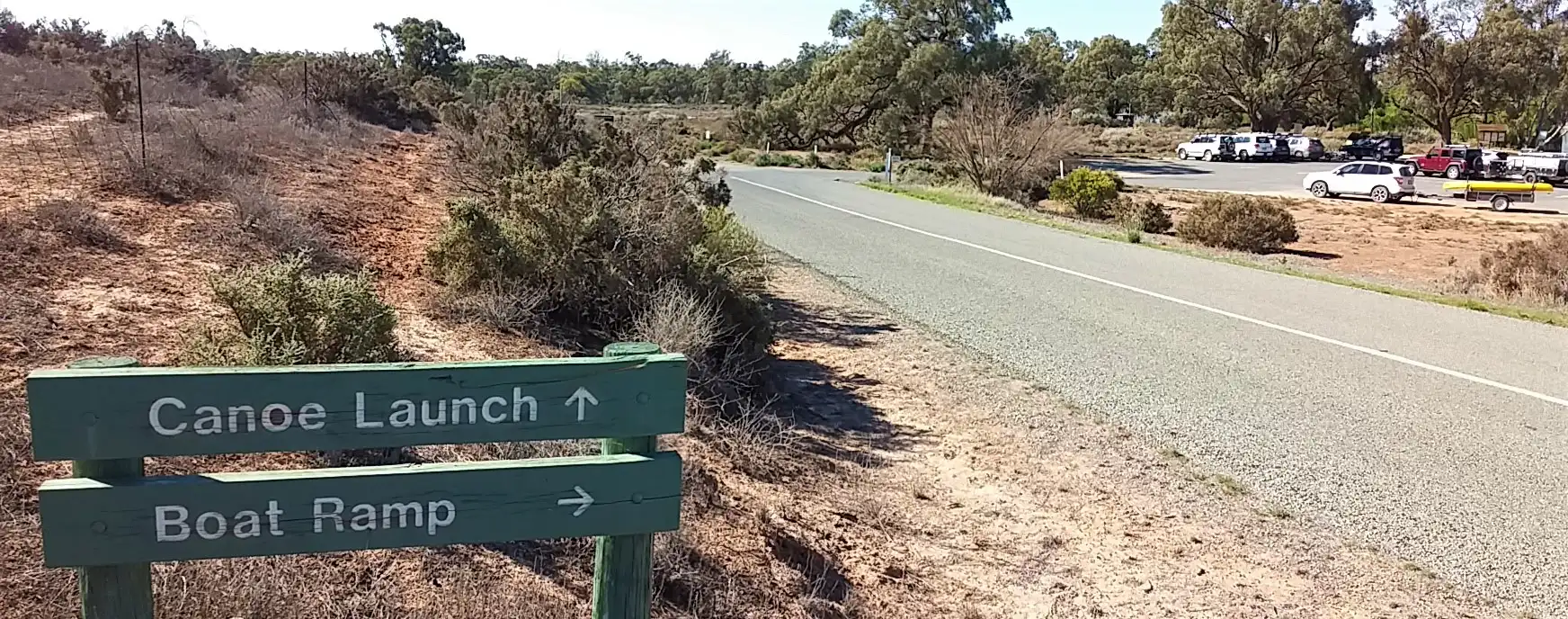
The trail starts and finishes at the canoe launch within the Border Cliffs campground, Chowilla Game Reserve. There is also a kiosk, grassy area, picnic table and BBQ at the old Customs House nearby — ask permission for access.
| Site | Location | Notes |
|---|---|---|
| Border Cliffs Campground Canoe Launch | GPS: 33.9727 S; 140.9575 E. Accessible via Murtho Road from Paringa. Shady trees and toilet at campground. Kiosk at the old Customs House nearby. |
Route Description
Route Description (Anti-clockwise)
- Launch → Hypurna Creek via the Shute (approx. 150 m fast water): From the canoe launch, paddle downstream on the Murray to Suders Creek and enter the Shute on the right-hand side of the river. The Shute is a fast-flowing, narrow creek approximately 150 m long that connects the Murray River directly to Hypurna Creek. Reconnoitre on foot before entering. Experienced paddlers only. Risk of being forced against fallen trees.
- Portage Alternative (adds approx. 2.2 km + 75 m portage): If the Shute is not suitable for your group, paddle upstream approximately 1.5 km to the portage point just before the 638 km marker (Point W: GPS 33.9828 S; 140.9686 E). Watch for a small “portage” sign nailed to a tree. Portage approximately 75 m into Hypurna Creek and paddle back downstream to the Shute junction. This alternative adds approximately 2.2 km to the route.
- Hypurna Creek → Point H — Salt Creek Junction (approx. 200 m): From the Shute, turn left into Hypurna Creek and continue approximately 200 m to the junction with Salt Creek at Point H (GPS: 33.9711 S; 140.9683 E). The stumps of an old footbridge are visible in the water near this junction when the river is low. Veer right into Salt Creek.
- Salt Creek → Point J — Punkah Creek Entrance (approx. 4 km + 750 m): Continue along Salt Creek. Two branches of Punkah Creek will appear on the left-hand side approximately 4 km along and again 750 m later at Point J (GPS: 33.9636 S; 141.0016 E). Turn left into either branch and head north.
- Punkah Creek → Point K (approx. 3 km north): Paddle approximately 3 km north through Punkah Creek to Point K (GPS: 33.9427 S; 140.9961 E). You will pass the old “scab inspector’s” hut and nearby graves on the right-hand side — these are not visible from the water but are approximately 500 m walk. The Littra campground is located nearby and is the recommended overnight stop. Note the brief narrow, fast-moving spot on Punkah Creek — proceed individually and take care not to be pushed into fallen trees. Todd’s Obelisk on the SA/NSW border is a 1.5 km walk north of Lake Littra.
- Point K → Point F — Slaney Creek Junction (approx. 15 km): From Point K, continue paddling for approximately 15 km to the intersection with Slaney Creek at Point F (GPS: 33.9410 S; 140.9326 E).
- Point F → Point G (approx. 3.1 km along Slaney Creek): Turn left into Slaney Creek and travel approximately 3.1 km to the next junction at Point G (GPS: 33.9555 S; 140.9531 E). Take the left-hand stream back into Salt Creek. Note: the right-hand stream has fallen trees and a difficult portage at the weir — best avoided.
- Salt Creek → Point H — Hypurna Creek Junction (approx. 2.9 km): Travel along Salt Creek for approximately 2.9 km to reach the junction with Hypurna Creek at Point H (GPS: 33.9717 S; 140.9680 E). Turn right into Hypurna Creek and paddle approximately 1.3 km.
- Point W → Murray River → Launch (portage + approx. 200 m): The portage point is marked by a rusted tin marker on the right-hand side at Point W (GPS: 33.9828 S; 140.9686 E). Portage 75 m back to the Murray River. Turn right — you will pass the Border Cliffs boat ramp to reach the canoe launch site.
Wildlife & Environment
Chowilla Game Reserve is one of the lower Murray’s most ecologically significant landscapes. It contains the largest remaining natural river red gum ( Eucalyptus camaldulensis) forest in the lower Murray, providing a vital habitat for a rich diversity of wildlife. The 18,000-hectare reserve forms an integral part of the Riverland Biosphere Reserve and is recognised as a Ramsar wetland of international importance — one of only six “The Living Murray” icon sites in the Murray-Darling Basin.
The mature river red gums that shade these waterways develop substantial hollows over time, providing nesting and shelter sites for a remarkable variety of animals — parrots, bats, possums, snakes and insects all rely on these ancient trees. Among them is the nationally vulnerable regent parrot ( Polytelis anthopeplus), which breeds exclusively in river red gum hollows along the Murray River, making the great stands at Chowilla particularly critical for the species’ survival.
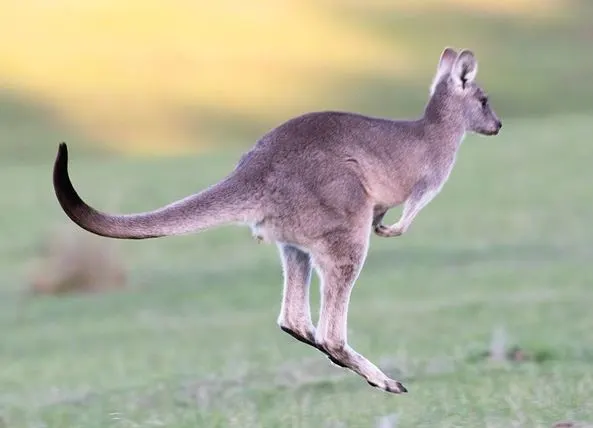
Birdlife is abundant throughout the reserve. The quiet waterways and wetlands support great egrets, superb fairy-wrens, white-faced herons, Australian shelduck, yellow-billed spoonbills and a wide variety of waterfowl. The reserve is an important refuge for waterbird populations across the region. Paddling at dawn, when the creeks are still and the red gums are alive with bird call, is an extraordinary experience.
The hardy black box ( Eucalyptus largiflorens) grows alongside the red gums on the higher ground, together forming the dominant woodland character of the reserve. The understorey and wetland margins support lignum, saltbush and dense reed beds that provide additional habitat for smaller fauna.
Country & Heritage
The Chowilla floodplain sits within the traditional Country of the Maraura people, whose ancestral lands extended west from Wentworth along the northern bank of the Murray River downstream to Chowilla and Ral Ral in South Australia. The Maraura spoke the southernmost dialect of Paakantyi and maintained a deep and intimate connection to the rivers, floodplains and wetlands of this country across generations.
The River Murray — Murrundi — is understood by the First Peoples of the river as a living body, formed during the Creation. Aboriginal people have lived along and with this river for tens of thousands of years, with the waterways providing food, connection and ceremony. River Murray and Mallee Aboriginal Corporation (RMMAC) rangers are actively involved in ecological monitoring across the Chowilla floodplain, including scar tree monitoring that records the ancient practice of bark canoe-making that brought Aboriginal people to these same waterways long before European contact.
Paddling Trails South Australia acknowledges the Maraura people as the Traditional Owners of the Chowilla Country, and pays respect to Elders past, present and emerging.
Historic Sites Near the Trail
The Chowilla area carries rich colonial history. In the 19th century, a sheep scab inspector’s station was established at Chowilla to control the movement of sheep across the SA/NSW border — a critical biosecurity post during a period when sheep scab disease threatened the colonial wool industry. The ruined hut and nearby graves associated with the inspector’s post are located approximately 500 m walk from the Punkah Creek section of the trail (near Point K), though they are not visible from the water.
A 1.5 km walk north of Lake Littra brings you to Todd’s Obelisk — the historic survey monument marking the South Australian and New South Wales border, set in place during the surveying of the colonial border in the latter half of the 19th century. The old coach road that ran through this remote country is also traceable nearby. These remnants of early European occupation sit in quiet contrast to the vast, ancient landscape surrounding them.
The former Customs House near the Border Cliffs campground was an important checkpoint for river traffic during the era when interstate customs duties applied to goods moved along the Murray. Today it is part of the Riverland Biosphere, and a grassy picnic area remains — ask permission before using the facilities.
Chowilla Game Reserve
Chowilla Game Reserve was proclaimed on 8 April 1993 under the National Parks and Wildlife Act 1972, in conjunction with the adjoining Chowilla Regional Reserve. The game reserve classification reflects the permitted activity of waterfowl hunting in designated areas on specified dates each year. It is classified as an IUCN Category VI protected area.
The reserve is managed by the Department for Environment and Water. For park maps, campsite bookings and current alerts (including closures for high river levels or environmental flows), visit parks.sa.gov.au.
Trail Gallery
4 photos